Out of Sight, Out of Mind. Not Out of Humanity. 2026
Council Members · Analysis · Homelessness Policy ·
MCSU+H is built for the Functional Unsheltered™ — the nearly half of all unsheltered people who aren't addicted or mentally ill, and who can move off the street on their own with the right tool.
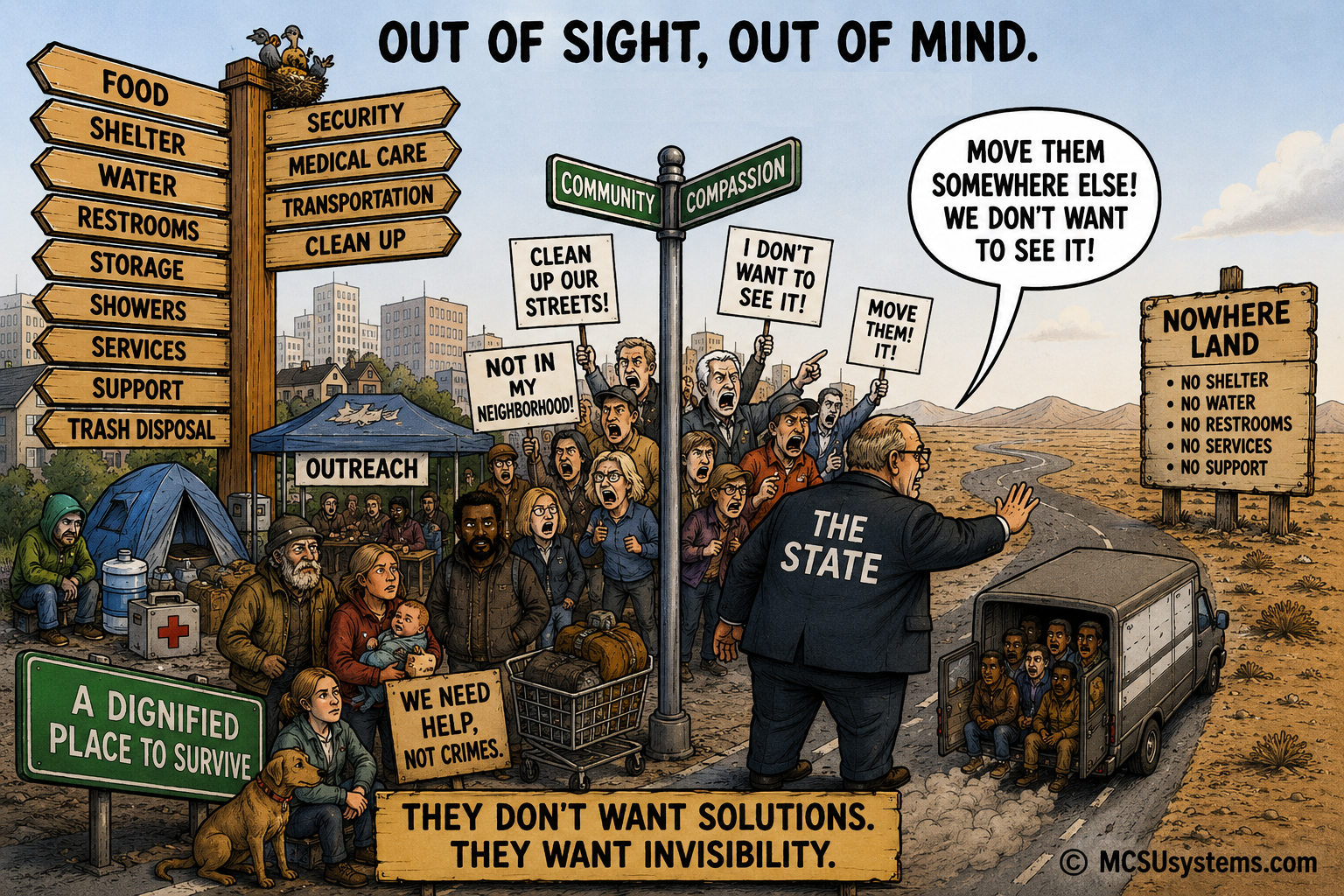
Twenty years of homeless sweeps and camping bans share one thing in common: they were never designed to solve homelessness. They were designed to solve the visibility of it. A new analysis shows why that can never work — and what the people who run cities are refusing to admit.
Out of Sight, Out of Mind. Not Out of Humanity. 2026
The problem is that homelessness is visible — and visibility, on a basic human level, produces a reaction that has nothing to do with solutions.
When housed residents see a tent encampment, they don't call their city council member asking for a housing plan. They call asking for it to be gone. That complaint drives sweeps. Sweeps drive policy. And policy, for two decades, has been almost entirely organized around making homelessness disappear from view — not from existence.
Download · Fill in · Sign · Email to [email protected] · 843-814-2007
Homeless people are always where food, water, medical care, and transit are — because those things are necessary to stay alive.
And that's exactly where you are located. In the neighborhoods, commercial corridors, and public spaces where housed residents live, work, worship, and play.
You cannot relocate a hospital. You cannot move a food bank to an industrial zone three miles from downtown and call it humane. You cannot run a bus line to nowhere. The survival infrastructure that unsheltered people depend on exists inside the general population — and so, by necessity, do the people who depend on it.
This is not a policy failure. It is geometry. The two populations — housed and unhoused — are permanently co-located by the structure of the city itself. Every sweep, every camping ban, every "move along" order runs directly into this fact and loses.
Full encampments typically reform within weeks. No sweep changes either number — because the people know where they have to be in order to live, to survive.
In recent years, a wave of state camping-ban legislation — built on nearly identical model bill language that has spread state to state — promised a different answer: designated areas. Sanctioned sites where unsheltered people could be directed instead of simply swept. A humane alternative, lawmakers said. A place for people to go.
Texas, Florida, and Kentucky passed the strictest versions of these laws. Texas's own state housing agency — the Texas Department of Housing and Community Affairs (TDHCA) — is required by law to publicly track every designated-camping plan submitted for state approval.
Florida's counties remain in certification limbo amid local opposition. Kentucky's Safer Kentucky Act has leaned almost entirely on enforcement, with no compliant site established. The designated area — the supposed alternative to the sweep — has failed to materialize in every state that mandated it.
The reason is the same reason sweeps fail: nobody will site a designated area near where survival services are — because that's where people are, and people don't want to see it. The designated area fails the same way the sweep did. For exactly the same human reason.
Can the visible reality be made dignified enough that it stops generating the political pressure that produces sweeps?
Constituents don't only complain about homelessness. They complain about tents, cardboard, open sanitation failures, and the feeling that no one is in charge. A tent encampment communicates disorder. A city-managed deployment of uniform units communicates something different: the city has this. It has a defined edge. Someone is accountable.
That distinction — between unmanaged visibility and managed visibility — is the only lever cities actually have. It doesn't solve homelessness. But it changes what constituents see, and therefore what they demand.
Ten to fifteen city-owned units — trackable at the municipality's discretion, like any other city equipment — read completely differently than a tent encampment. Not because the people are different. Because the city is visibly present.
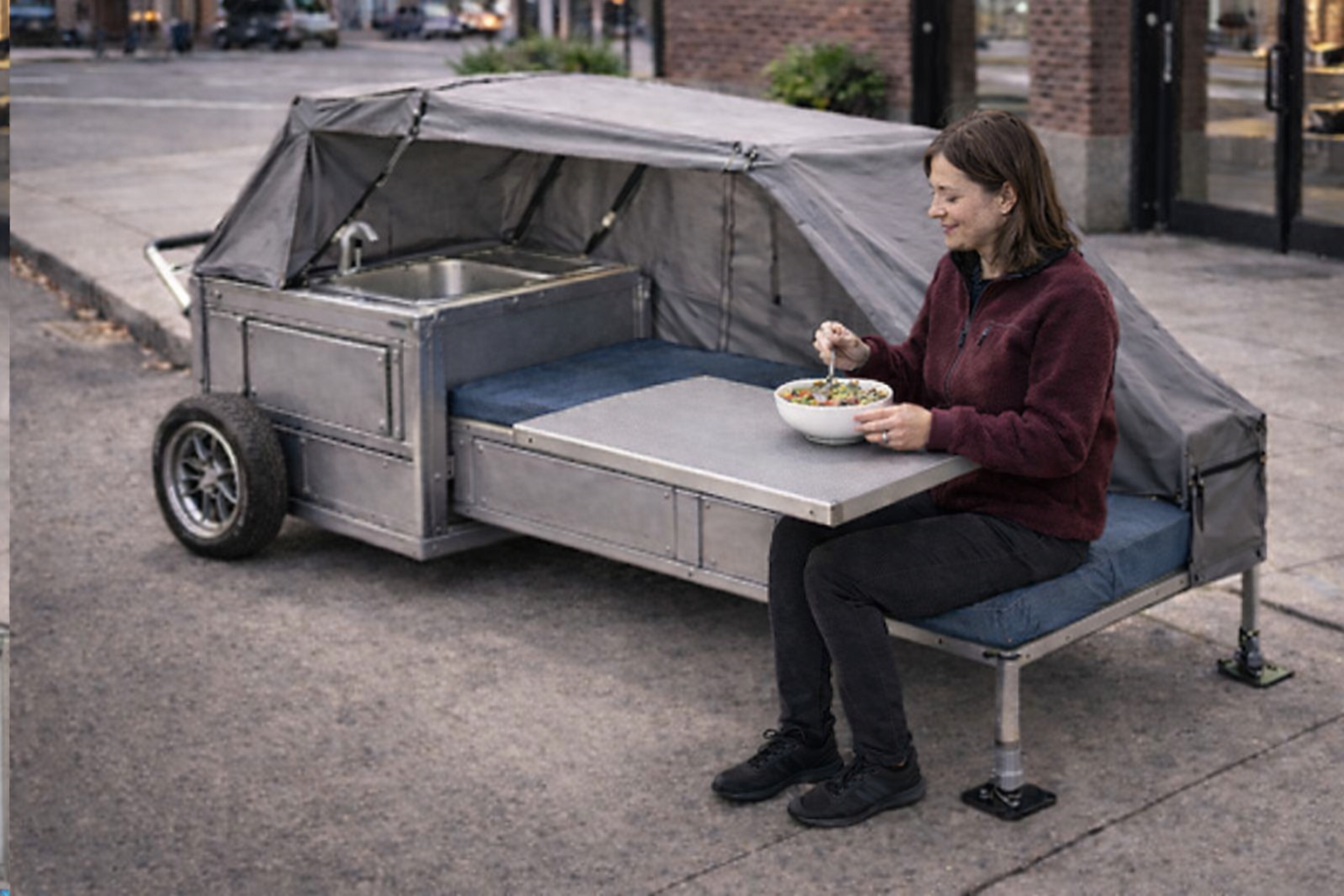
The MCSU+H (Mobile Cart Support Unit + Hygiene) was designed specifically for this problem. City-owned equipment — and, at the municipality's discretion, trackable the way any other piece of city equipment can be. That's a management option for the city, never a requirement placed on the person using the unit.
It solves what we call The Homeless Shuffle™: the city sweeps a site, but people keep coming back to the same location because it's close to their survival needs — food, water, medical care, transit, restrooms, support services.
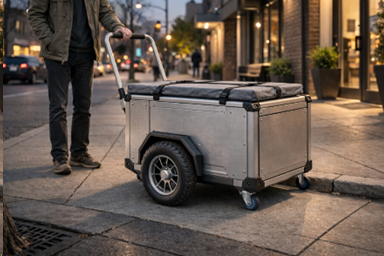
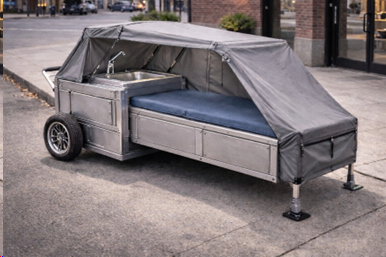
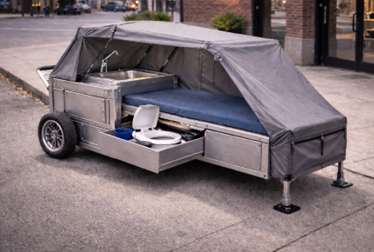
The MCSU+H is a patent-pending, city- or non-profit-owned mobile unit built on a cart-sized frame. One person can deploy it in under two minutes. It provides a twin-size bed, a weatherproof canopy enclosure, sink/faucet with running water, a toilet, a small flip-up dining table, and a lockable storage area. The wheels lock to prevent theft. It does all this without needing a large permanent facility that takes months to site, approve, and build.
Where the person goes, their bed, hygiene, sanitation, and protected documents go with them. Click here to view images →
It doesn't remove homelessness from public view. It removes the most distressing visible symptoms of it — the ones that generate the complaint calls that produce sweeps. Dignity that the public can see. Management that constituents can trust. Survival infrastructure that exists where people already are.
See the unit → Put your city on record — download the Letter of Interest →
Prototype completes end of 3rd quarter 2026. Cities that submit a Letter of Interest now get priority placement for a demo before public scheduling opens in 4th quarter.
Patent Pending No. 63/987,871